Introducing Data Skills
Repeatable prompts that let data teams teach agents how to handle complex analyses on demand — codified once, reusable forever.

Bobsled Team
May 18, 2026
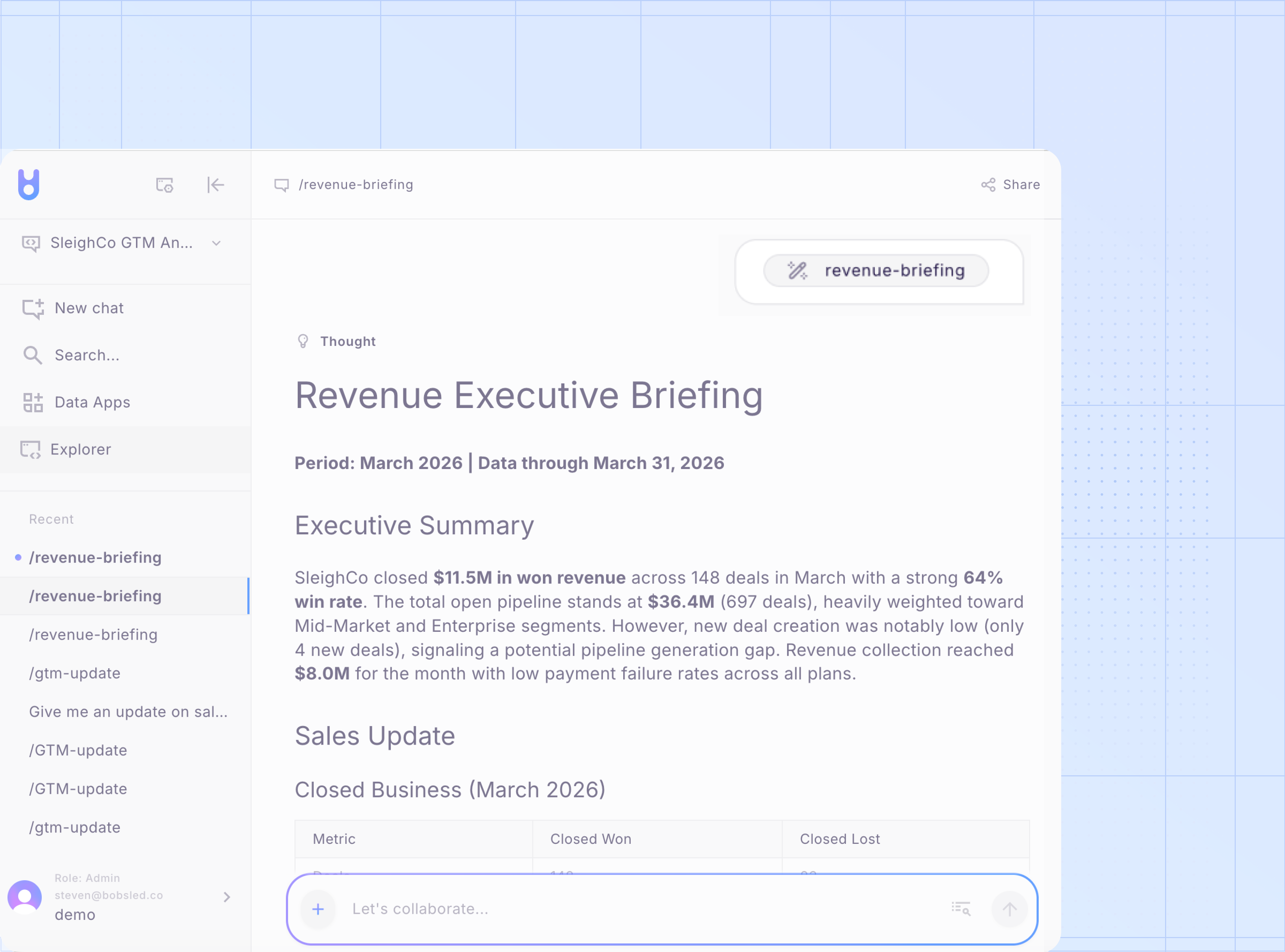
Today we're launching Data Skills in Bobsled: repeatable prompts that let data teams teach agents how to handle complex analyses on demand.
Data teams spend most of their time fielding versions of the same question. Some can be answered with a dashboard. Most still end with an analyst running a stored procedure and pasting the result into a chart or deck.
With Data Skills, the agent does that work. A sales leader asks for a "quick run-down on March." The agent recognizes it's prep for her QBR, pulls revenue, CAC, and churn, and drops the numbers into three slides in the approved format — without anyone touching SQL.
How it works
Skills are prompts defined by data teams or end users, then invoked autonomously by the agent or explicitly through a slash command.
Create skills as you work: Notice yourself running the same prompt every week? Tell the agent to save it as a skill, and it'll invoke that prompt next time on its own. No re-explaining.
Share across the organization Keep skills private or publish them to your team. Skills built by one analyst become reusable workflows for everyone, and data teams can govern which ones get promoted.
Take action, not just answers Skills do more than return a number. Pair them with tools to build decks, generate PDFs, or update downstream systems in the same run.
How teams are using Data Skills
QA without a quant. A PM types /run data quality check before a client meeting. The agent walks through freshness, completeness, and anomaly detection — flagging real issues, not noise — and returns a shareable report. No SQL, no ticket, no waiting.
Recurring reports on autopilot. Every Monday, the ops team needs the same weekly business review — same metrics, same cuts, same format. A skill assembles it from the source of truth, on demand or on a schedule, so the analyst who used to build it spends Monday on something harder.
Advanced analytics, codified. A growth lead types /run customer segmentation on the trial cohort. The agent applies the features your senior analyst picked, runs the clustering model with the team's chosen k, labels each segment using the team's naming convention, and returns a chart with sizes and defining traits. The decisions that took months to land — which features matter, how many clusters are real, what to call them — get applied automatically every time.
Getting started
Data Skills are live. Go build something.
- Ready to build? Book a demo